Your business
on autopilot
We build the site, the app and the automation behind them as one system, so the routine runs itself and you spend your time on the business.
Principles
that drive our work
Skip the words "quality" and "reliability". Here are four things you can check before you sign anything.
Discuss the projectProcess
Transparent project trajectory
ProcessYou always know where the project is. Updates come every week, the board is shared, and every change of scope is written down before the work, so there are no surprises at the end.
- Weekly updates
- Shared board
- Changes in writing
After launch
Long-term partnership
After launchLaunch is where the work starts paying off, so we stay after it: we keep the product stable, answer questions and add the next features as the business needs them.
- Maintenance
- Consultations
- Next iterations
Architecture
Architecture for growth
ArchitectureWe design for the load you will have, not the load you have today. When the business grows, the system grows with it and nobody has to rebuild it from scratch.
- Load in mind
- Clean data model
- No rewrite later
Research
Deep understanding of your business
ResearchBefore we design anything we learn how your business actually works: who does what, where the time goes, what the customer needs to see. The product then fits your process instead of the other way round.
- Interviews
- Process map
- Your vocabulary
Solutions
we provide
Four directions, one team. The site, the app, the configurator and the automation between them are built by the same people, so nothing gets lost in a handoff.
Web Development
5 included
Corporate sites and web platforms that do real work: they bring in clients and take over the routine behind the scenes, from orders to reports.
- Landing pages and corporate websites
- Custom web applications
- API development and integration
- E-commerce platforms
- SaaS solutions
Mobile Development
3 included
Mostly apps that share a database with your site, so the two work as one system. We also build standalone apps when the task calls for it.
- Responsive web applications
- Cross-platform mobile apps
- Progressive Web Apps (PWA)
3D configurators
4 included
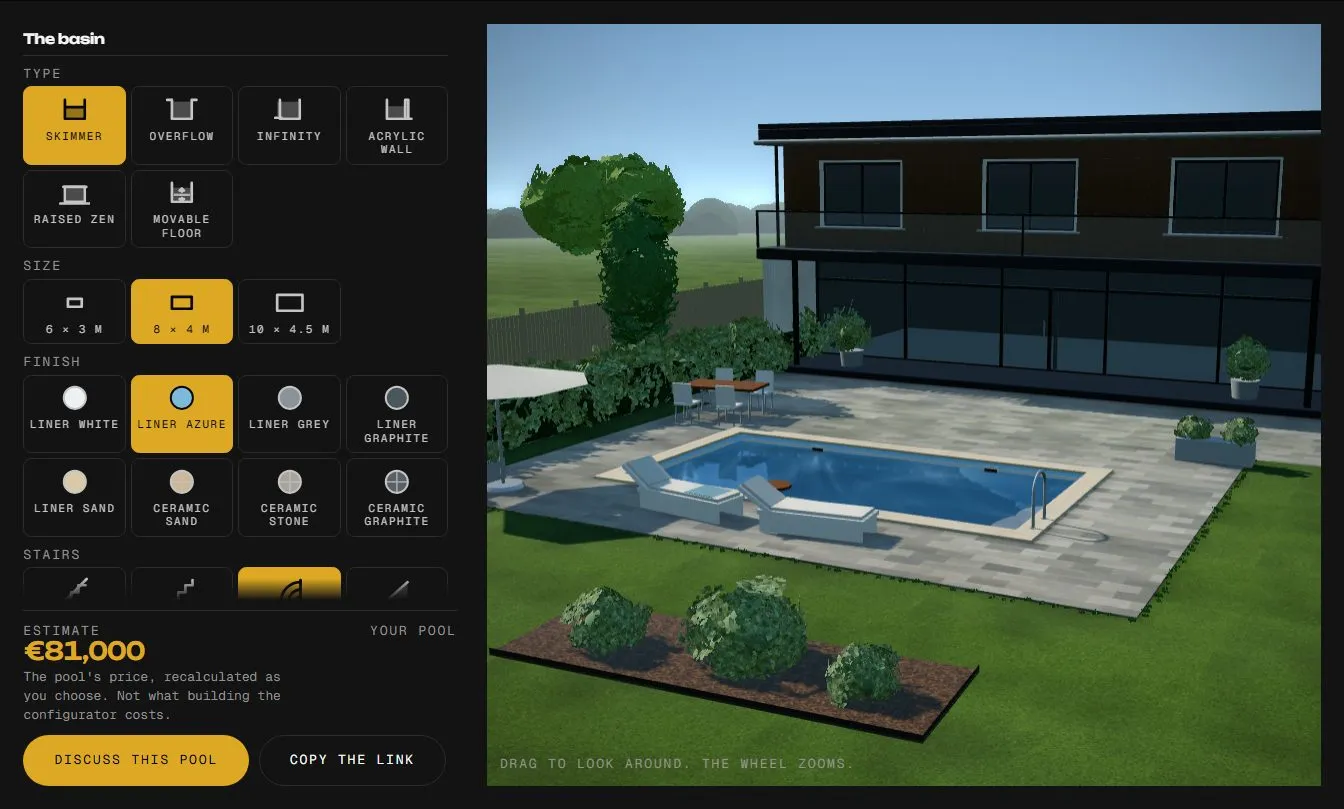
A product the customer assembles in the browser: a pool, a garment, a piece of furniture, anything sold with options. The price updates as they choose, and the order arrives with the configuration attached. Two of ours are running on this site.
- Product configurators on WebGL
- Live price calculation
- Print and material previews
- Order and CRM integration
Automation and Bots
3 included
We look at what your team does by hand every day and replace it with code: scripts, bots and integrations that run in the background while you work on strategy.
- Automation scripts
- Web scrapers and data parsers
- Telegram bots
Your project
step by step
1

Requirements and planning
We learn how your business works before we draw a single screen.
- Interviews and a process map
- Scope with a fixed price
- A plan with dates
2

Design and prototype
A prototype you can click through before any code exists.
- Screen map and user flows
- Clickable prototype
- Design system
3

Development and testing
Built in short iterations. You see each one on a test server.
- Weekly builds
- Load and security checks
- Documentation and handover
4

Launch and support
We launch together and stay on after release.
- Deployment and monitoring
- Training for your team
- Updates and new features
Our
Projects
Sites, platforms and internal tools that run their business every day.


NEOMED+

ONIX
Try it
yourself
Two configurators you can use right now, in the browser. Your customer builds the product and watches the price change, without signing up or booking a demo.

Questions we get asked
Short answers to the things people ask before the first call.
How much does a website or web app cost?
A landing or corporate site starts from around €1,500. A web application or platform starts from €5,000 and goes up with the number of integrations and the scope. You get a fixed estimate before the work starts, and any change of scope is agreed in writing rather than showing up in the invoice.
How long does a project take?
A corporate site takes 2 to 5 weeks. A platform with accounts, payments or a custom admin panel takes 2 to 4 months. KortyOnline went from the first call to a working platform in three months.
What technologies do you work with?
Whatever the task needs. We are not tied to one stack. What we reach for most often is React and Next.js on the front end, Django and PostgreSQL on the back end, and Docker for deployment. For automation it is Python, Telegram bots, n8n and Make, plus the OpenAI API where a language model actually helps. If your product already runs on something else, we work in that.
Do you work with clients outside Poland?
Yes. ILUXA WEB is registered in Poznań, Poland, and works with clients across the EU and beyond in English, Polish and Russian. Calls, documents and support are in whichever of the three you prefer.
What happens after launch?
We stay. Hosting, monitoring, updates and the next iterations are part of a maintenance agreement, so the product keeps working and keeps growing with the business.
Can you automate a process we do by hand?
Usually, yes. Order intake, file handling, reports, CRM updates and messaging are the common ones. We map the manual steps first, then replace them with scripts, bots or integrations. YASTUNING got four hours a day back this way.
Get in touch